Suzanne has written many books, including 'Beautiful Birth' which is available to buy from Born.
How can receiving shiatsu and massage in pregnancy support your baby’s development as well as supporting your own posture and well being
Much has been written about the benefits of touch in supporting pregnancy by promoting relaxation, connecting with your body and baby and easing the “complaints of pregnancy” such as back ache, nausea and preparing for birth.

Supporting awareness of different positions in pregnancy
However I want to focus on another benefit of shiatsu and massage: supporting awareness of the different positions in which you work and rest. Having a range of different positions can help you feel more comfortable and enjoy your pregnancy more, but it’s also good for your baby’s development.
Pregnancy positioning myths
I have found over the last 25 years , despite the increase in awareness of massage and yoga, that not only are women, and men, moving less, but also there seems to be a lack of knowledge, or even fear, about positions that one should rest or exercise in while pregnant. A common myth is that the left side lying position should always be favoured over the right, and in some extreme views, that the right side position should be avoided as much as possible. Another myth is that for all women lying supine after the first trimester is dangerous. While it is true that left lying may be more comfortable for some women than right lying, and some women can’t lie supine without feeling dizzy or uncomfortable, this is not the case for all women.
Learning to listen to and trust your body
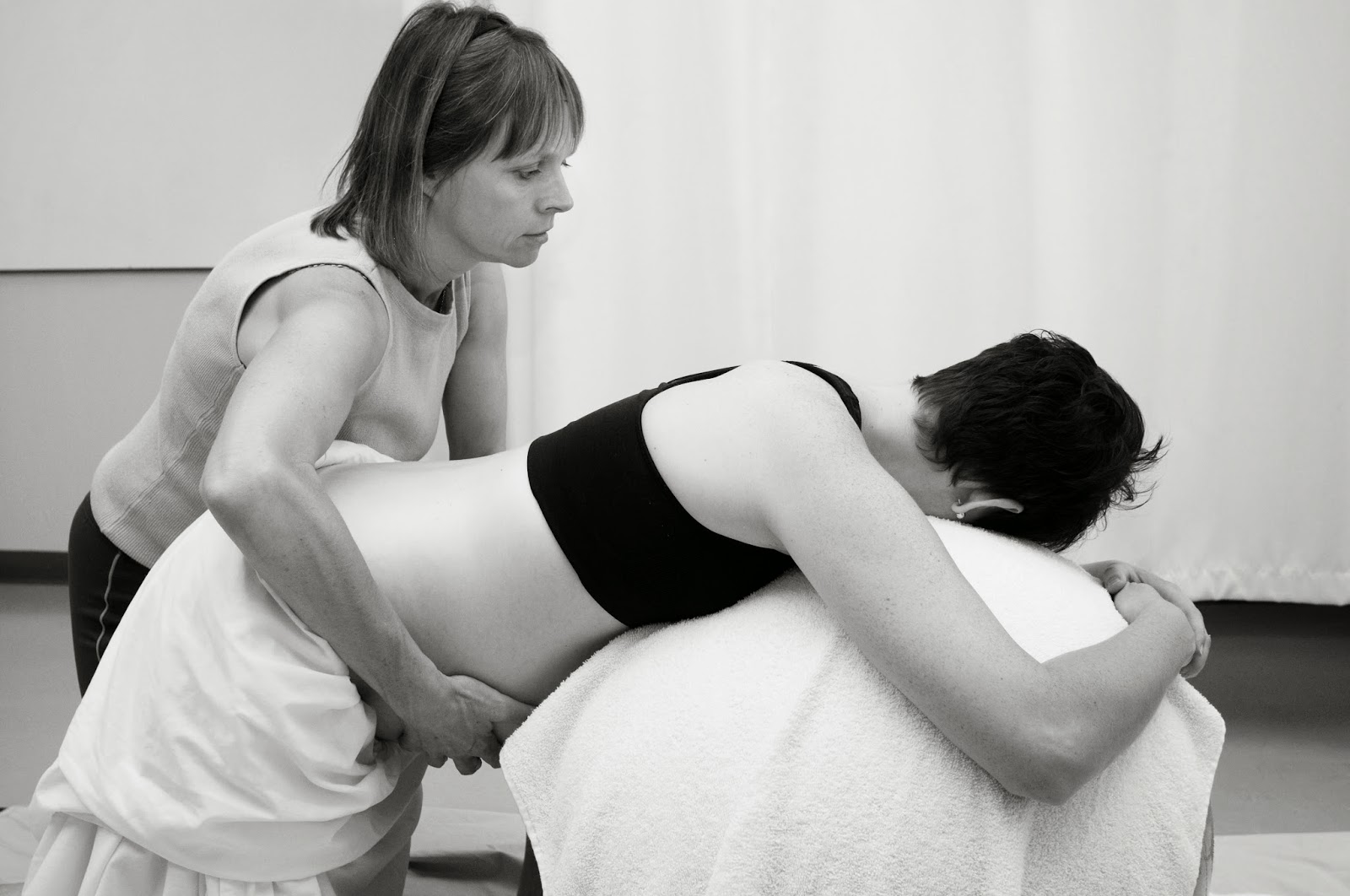
So in my work, both in teaching therapists and working with mothers, I emphasise the importance of spending time supporting the mother to start trusting her own feelings about her body. I want a pregnant woman to feel able to listen to her own body, rather than forcing herself to stay in uncomfortable positions because she thinks they will be better for her and her baby. When a pregnant mother first comes for a treatment, I spend time working out which positions are comfortable for her, not only during the treatments, but also with ideas of how to sleep and rest comfortably, as well as looking at how she sits at a desk and how she moves. It is important to find the right kind of supportive cushions and to offer as many different options as possible. This can include, supine where appropriate, semi reclining, side, sitting, forward leaning.
Positions and movements in Labour
Listening to your body in this way will also help prepare you for labour and be able to find positions which you will find comfortable then. It will also help you get prepared for exploring appropriate positions for feeding, carrying and exercising with your baby after birth. I want women to appreciate that what is comfortable is different for every woman and also varies from day to day. Nothing is fixed!
Benefits of all fours
It is helpful to include some massage or shiatsu with the woman in the all fours position: this is not only excellent for alleviating lower back ache and helping the baby rotate more towards the anterior position, but also helps prepare the mother for labour and helps her have a different awareness of her pelvis.
How are we blocking our pelvises?
Due to the increased time spent sitting at computers and driving cars, a lot of pressure builds up in the pelvis. This may cause back ache, especially with the increased weight of the baby during pregnancy. It also has the effect of making the muscles in the pelvis become lazy, potentially leading to pelvic girdle instability. This is why it is important to offer options of other positions and movements which can be included in day to day activities, not simply attending classes. However, this lack of movement also affects babies. A lot has been written about how this has led to an increase in posteriorly positioned babies, and babies getting stuck during labour. However, I am increasingly concerned about how this affects the development of the baby. Babies develop through movement and ideally the womb should provide a rich environment as the mother moves around and adopts different positions. As the mother moves less, so also the baby moves less. So during my work I emphasise the importance for women to be aware of how their baby changes position as they shift in the different positions during the treatments.
Postnatal positions for mother and baby
I find that this increased awareness of the baby helps the mother be aware of the importance for the baby to move postnatally. It is great that carrying babies is becoming more popular these days. However it is important for the mother to think about how she is carrying her baby and to vary the positions. A lot of women come to me and therapists trained with me, with hip and shoulder and carpal tunnel problems caused by carrying their baby on one hip. This will also affect the babies left/right side development. It is important that a baby gets a full range of stimulation by being carried on both sides as well as on the mother’s (or father’s) front and back. You can see a wide selection of good carriers in Born's Carriers section.
Putting babies on their tummies
Another of my concerns with lack of movement for the baby after they are born is how little parents place their baby on their tummy. Due to concerns over Sudden Infant Death Syndrome, parents are encouraged to put their babies on their backs to sleep. However many parents become afraid of putting their baby on their tummy when they are awake. I see many babies who are rarely, if ever, put on their tummy. This leads to them developing flat heads and also less muscle tone in their backs. They tend to start crawling later than babies regularly put on their tummies and sometimes do not crawl at all. This has a long term implication for their future physical and even brain development as brains develop through movement. I make sure that I include this awareness when I teach mothers infant shiatsu and massage.
It’s amazing, isn’t it, how such a simple thing as being aware of your posture, has such profound implications; both for mother and baby.
This is a guest Blog by Suzanne Yates of Wellmother.org


